With another SummerSlam in the books and Sunday Night’s Main Event around the corner, many fans are left feeling somewhere between meh and eeh. That’s not to say that WWE’s biggest party of the summer didn’t have its moments. However, the company’s creative malaise coupled with its commercialized presentation has led to one unfortunate conclusion. As far as PLE events go, the show we got at SummerSlam is as good as it’s going to get, and it is a byproduct of WWE’s new era.
U.S. Bank Stadium was the site of the 39th annual SummerSlam. Each night featured six matches over three hours. Some matches got time to shine, including the two world title bouts. Other matches, like Hell in a Cell, had just enough time to tell their story. Then, there are the rest of the matches on the card that had no time to breathe, such as the Intercontinental Championship match.
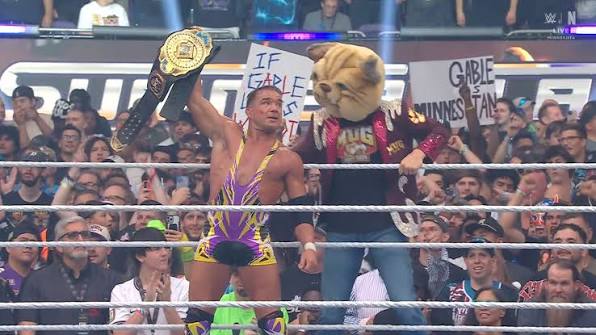
Chad Gable finally won his first singles title at SummerSlam when he defeated Penta to become the Intercontinental Champion. While Gable is a great wrestler, he’s not the most entertaining character, except when he’s Grande Americano. Gable’s wrestling is what gets him over. Still, an 11-minute match before the main event didn’t allow Gable/Penta to live up to the legendary SummerSlam IC title matches WWE mentioned to promote the encounter, such as Hart/Bulldog in 1992. Gable tapped out Penta with the ankle lock to secure the win and got to celebrate afterward with his family and the Mug Root Beer mascot.
That’s right, folks. A soda mascot was the featured spot during Gable’s big title win, and not the win itself. WWE’s commercialization is now in full swing. Sponsorships are not just an important goal; they are THE goal. Everything else- matches, storylines, wrestlers comes in distant second place. WWE fans are now seeing what UFC fans have endured for years. Sell everything. Monetize every inch of real estate. It’s a business plan many have implemented before TKO, and more will do so in the years ahead.
While WWE is clearly in a creative slump, its parent company, TKO, is the root of the problem. The philosophy of less is more is to exhibit how someone can get a maximum return on an investment without doing too much, whether in artistic or monetary terms. TKO applies the idea quite literally, looking to make as much money as possible by doing the bare minimum, all in service of one objective. To make WWE the attraction instead of the wrestlers.
Artists, actors, and performers in every genre have heard that the door to commercial success is open a lot wider than the door to critical acclaim. The same goes for industry and companies, which is why it’s hard to blame TKO for going the commercialization route with WWE. Right now, it is working for them. Sure, SummerSlam ticket sales were disappointing enough that WWE didn’t even announce the attendance for either Night 1 or Night 2. However, that is most likely the exception, not the rule.
WWE has stopped running house shows, which is a double-edged sword. Veteran wrestlers are saving the amount of bumps their bodies can endure, but younger wrestlers aren’t getting enough reps in the ring. TKO has stated its focus is more on television with a few house shows sprinkled in. It is easier to monetize a TV show than a non-televised show. That said, if WWE found a permanent or long-term presenting sponsor for its house shows, there would be no shortage of events.
Look, such melancholy musings normally wouldn’t occupy page space here. However, this down period in WWE feels permanent. It’s hard to argue with the current monetary success, but it’s inadvertently or perhaps deliberately positioning storytelling/creative as a mere goal instead of the means. In UFC, advertisement overload won’t ruin a good fight because, unlike WWE, you can’t alter the script to have a giant Minute Maid juice carton run amok in the octagon.
Whether it’s a symptom of the era or the result of a well-executed plan, WWE will churn out some riveting television from time to time. The Bloodline 2.0 got their comeuppance on Raw when the “delivery” of Solo Sikoa blew up in their face, making for an excellent angle that put a lot of shine on Sikoa, LA Knight, and Jacob Fatu.
Eras in WWE are defined by the overarching element that influences every facet of the operation. We’ve had the Attitude Era, Ruthless Aggression Era, PG Era, Reality Era, etc. Welcome to the Commercialization Era.
Now, if you excuse me, I need to go to the store. I suddenly have a craving for root beer.


