DC Comics and AEW Team Up for Epic Crossover

Who would win in a fight between Batman and Kenny Omega? How about a showdown between Wonder Woman and “Timeless” Toni Storm? Can the acrobatic Nightwing match the aerial arsenal of Will Ospreay? These questions could be answered when the heroes and villains of All Elite Wrestling (AEW) and DC Comics unite for a groundbreaking collaboration. The main event of this partnership will be a 48-page, two-part comic book saga. 

Continue reading “DC Comics and AEW Team Up for Epic Crossover”

Scooby-Doo! and Krypto, Too! (Review)

It’s time to gear up for another Scooby-Doo adventure with Mystery Inc. as they join forces with Krypto, the Superdog, to investigate the mysterious disappearance of the Justice League.

Scooby-Doo! and Krypto, Too! is the latest collaboration between Hanna-Barbera and DC Comics.

It’s part spiritual successor and another part straight-up sequel to the famed ensemble cartoon of the 70s and 80s, Superfriends.

There’s plenty of Easter eggs to gawk at for old-school fans.

Continue reading “Scooby-Doo! and Krypto, Too! (Review)”

DC’s Event Leviathan Flounders with Finale

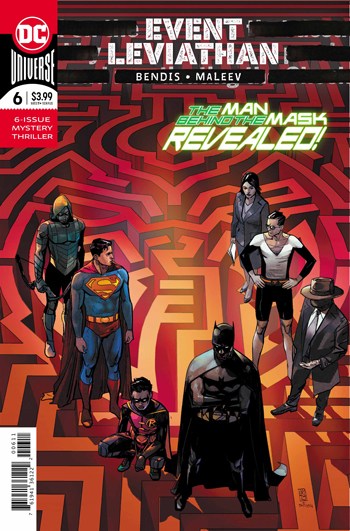
Event Leviathan #6 | Written by Brian Michael Bendis | Art by Alex Maleev | DC Comics

The biggest mystery plaguing the DC Universe reaches its conclusion. Who is Leviathan? We finally get our answer.

“I’m sorry, I don’t recognize you,” unfortunately, encapsulates the magnitude of the reveal when Superman used his x-way vision to peek under the hood.

Unmasking the villain needs to be a shocking experience.

Instead, Bendis used the moment to bring an obscure character to prominence.

That could have worked.

However, we never saw Leviathan actually do anything. Explosions, weird energy fields, and the collapse of the intelligence community wielded massive results.

Yet, Leviathan is never seen pulling the trigger himself or getting his hands dirty. He talked a big game and had people do his bidding. If Leviathan was going to roll up his sleeves finally, this was the time to do it. Instead, he retreats once he realized Superman would never join his cause.

I’m sorry, but how many times has Superman been fed the “Tear down the world to make it better” speech?

A lot would be the answer.

Its as if the characters in the book failed to realize something the reader has known about Earth’s greatest hero. I thought something different would have presented itself. Perhaps an argument that was fresh and compelling. Something to make Superman waver, even for a few fleeting seconds, would have given readers something to chew on.

Leviathan was portrayed as someone who is always five steps; however, he put all of his eggs in one red and blue basket. That doesn’t sound very smart al all.

The leaks that appeared online last month regarding Leviathan’s identity were correct.

I hoped they were wrong; however, it seemed too apparent after really thinking about it. The ending of the book is the beginning, as there is more to come from Leviathan. That would have been cool if I actually cared about the person in question. Leviathan peaced out once Superman turned him down.

Why would I be intrigued about any threat he could pose to Supes or the Justice League going forward?

Bendis is in the Leviathan business for the long haul. I hope he can bring something that will have an impact because, unfortunately, this wasn’t it.

Mera: Tidebreaker – Review

Written for and published by Forces of Geek March 2019

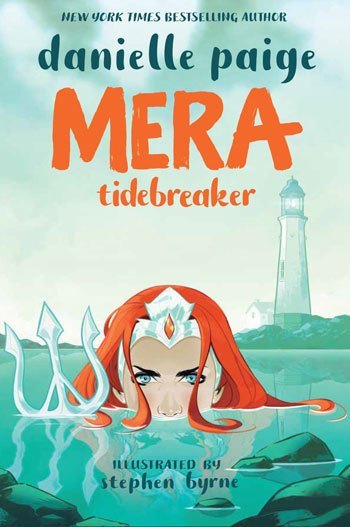
Mera: Tidebreaker is the initial offering from DC Comics’ young adult readers imprint, DC Ink. New York Times bestselling author, Danielle Paige, and animator Stephen Byrne collaborate on this tale featuring the future queen of Atlantis.

Yearning for a life that is truly her own, Mera sets out to bring peace between Atlantis and her home of Xebel.

She has to kill an unsuspecting Arthur Curry to accomplish her goals.

The reimagining of the Aquaman mythos doesn’t stop there. Arthur is sans the blonde hair, the inhabitants of the Trench are no longer monstrous creatures, and the beginning of a particular origin story underwent some minor alterations.

However, every change that was introduced is in service to the journey of the titular character.

Not to be stereotypical of the YA genre, but Mera and Arthur’s blossoming kinship was a given before the first turn of the page.

Strong character building by Danielle Paige established clear motivations that made the antagonists and protagonists earn every narrative inch. Obviously, Mera wasn’t going to kill Arthur; however, her observation of his kindness slowly chipped away at her cold murderous intent.

Make no mistake about it, Mera oozes teenage royalty. Still, while another princess might be overly concerned with their ensemble for the next big gala, Mera makes it clear that she is more than just a pretty dress. Light comedy sprinkled throughout the book such as Atlantean vernacular, “You got to be sharking me,” will bring about a few smiles along with some fish out of water hijinks.

It would have been easy for Mera to get lost in her own story, but Paige gives the multitude of subplots plenty of time to breathe and marinate. The final act is chock-full of revelations, but it is beautifully synchronized with the main story.

Stephen Byrne’s artwork exhibits a submersible pallet serving as a constant reminder of the books oceanic backdrop. Mera’s hair stands out like a red rose in a black and white portrait. This creative choice augments her presence, especially if the reader remembers nothing about Mera’s heroism and convictions.

Despite Aquaman being massively popular right now, producing a Mera-centric story was a gamble. Mera is a secondary character who doesn’t have a celebrated story such as Supergirl, Catwoman or even Black Canary. Geoff Johns made Mera an essential part of Aquaman’s New 52 run. However, no one has ever talked their favorite Mera moments on the playground.

Danielle Paige’s story is a big leap in that direction. The exploration of duty, love, valor, and liberty through the eyes of underwater royalty works exceptionally well. If the goal of this graphic novel is to make the reader a bigger Mera fan than they were going in, mission accomplished.

Green Lantern/Huckleberry Hound Special #1 Review

                                     Written for and published by Forces of Geek October 2018

Green Lantern/Huckleberry Hound Special #1 | Writer: Mark Russell | Artist: Rick Leonardi | Publisher: DC Comics

An image of the KKK waving hello to Huckleberry Hound as they drive by his house on a Mississippi evening utterly conveys the edgier settings of the critically acclaimed Hanna-Barbera/DC Comics one-shot crossovers.

Set against the turbulent backdrop of the early 1970’s, John Stewart, a rookie in the Green Lantern Corps goes home to Earth where the political upheaval of the Vietnam War and the violence of the Civil Rights movement confronts him at every turn.

Many of us have probably wished at some point in our lives for a superhero to leap out of the comics and fix the world’s problems.

Russell examines the pros and cons of this real-world scenario as for whether Stewart, who wields the most powerful weapon in the universe should use it to stop racial atrocities.

The narrative uses a struggling Huckleberry Hound as the voice that is begging for the power ring to be used, while other plot elements argue the opposite.

Stewart’s struggle to resist smacking down those who worship evil’s might is what brings everything together to produce an entertaining and provocative story. Artwork checks all of the boxes and makes excellent use of expressive character work to convey what word balloons can’t.

It can be hard to take these one-shot comics seriously because the Hanna-Barbera side of things is a far cry from what we used to know. Putting that aside makes a pairing such as Green Lantern and Huckleberry Hound an exceptional way to approach serious issues without trivializing them while using a unique hook to provide enough of the escapism readers look for in comic books.

Rating: A-

Justice League: Review

Divisive is the name of the game when it comes to DC Comics’ films. Man of Steel, Batman v. Superman, and Suicide Squad all received mixed reviews. Wonder Woman was a bonafide hit with everyone, but now it’s back to the status quo with the latest film in the series, Justice League.

Digital mustache removal, crappy CGI, inept story, and a botched Superman resurrection led to a massive critical lambasting of the film. Bad reviews don’t scare me out of seeing a movie because I need to see it for myself before casting judgment.

Is Justice League another step down for the DCEU? Is Justice League worth your time and hard-earned money? I’m here to report that Justice League is freaking amazing despite any minor problems, and these issues do not distract from an enjoyable movie. Continue reading “Justice League: Review”

Justice League Dark: Review

With Doctor Strange bringing the Marvel Cinematic Universe into the realm of sorcery and magic, Warner Bros. Animation does the same with their latest direct to home video offering through DC Comics, Justice League Dark.

DC animated films have been able to hit a lot of notes that their live action counterparts have missed. Of course, the bigger the budget, the larger the amount of creative red tape that will wrap itself around a project such as David Ayer’s Suicide Squad.

Justice League Dark makes great use of its sixty-minute run time in setting up the story, introducing the characters, and establishing their motivations to get the viewer invested in when the team finally comes together in the climactic showdown. It’s a formulaic approach to storytelling with the key elements executed to their desired result as the film opens with random acts of murder that end up being not so random. The mystical element to these atrocities calls for a different solution outside of Superman and company.

Enter John Constantine, who is quickly sought out by Batman, Zatanna, and Deadman to investigate the mystic anomalies occurring around the globe. When you think of Constantine, Matt Ryan immediately comes to mind. His portrayal of the supernatural detective has earned a great deal of praise, which has brought him back to the role through multiple platforms. Ryan’s voice acting served the story well here and carried a gravitas in the same vein as Mark Hamill’s Joker or Kevin Conroy’s Batman.

Speaking of Batman, his inclusion in this film has been met with a lot of eye-rolling from those who cherish the source material. The Dark Knight wasn’t a member of the Justice League Dark in the comics. And why would you need a non-powered detective when you already have a magical one in Constantine? It’s obvious that Batman is a promotional vehicle used, which is why he’s front and center on the Blu-ray cover.

I’m happy to report that Batman is a marketing version of a Trojan horse this time around. Batman serves as the bridge to the characters that mainstream audiences might not be familiar with. Once the mission is established, Batman hangs back, helps when needed, and cracks a joke or two while serving as a reminder that this is not a job for “capes and tights.” This prevents his inclusion from being a bait and switch, which benefits the film as Constantine, Zatanna, and Deadman are given plenty of room to work.

Jay Oliva, who has directed several DC animated films, delivers some exciting action and an entertaining narrative with intriguing twists and turns. Blood, guts, and curse words are all wrapped up in a violence-filled package that is worthy of the R-rating that the film is marketed with. There are no sexually suggestive themes or bloodbaths for the sake of shock and awe. All of the gory moments fit the context of the story. There are a lot of moving pieces that are not hard to follow, but still, there is much to absorb.

Besides the story, there were some fun moments such as Deadman sarcastically pointing out the obvious, Batman using a defibrillator to take out a shit-demon, a poker game where both parties cheated, and Swamp Thing. Man, I wanted more Swamp Thing. He looked glorious with great attention to detail, with his towering leafy green presence.

Aesthetically, the animation doesn’t stand out. It’s not bad, but despite the enjoyable action set pieces, there were no moments that would make you stand up and marvel over the imagery on-screen. There were also a few background blunders with one, in particular, showing Superman standing behind Constantine, only to see that the Man of Steel is nowhere in sight once the shot goes wide. It was annoying because it made me feel as if I missed something.

Gods, Spellcasting, magical stones, a bit of Merlin, and some Batarangs make for an animated DC Comics adventure that is fun to watch but not necessarily worth rushing out to see or buy on release day.

Those who came to see Batman save the day might be disappointed if they are not intrigued by the likes of Constantine and Zatanna. Justice League Dark does offer a better-than-average viewing experience that entertains on many levels while providing a worthwhile introduction to the House of Mystery and its residents.

Exploring the Origins of Suicide Squad: A Comic Retrospective

With Suicide Squad’s theatrical release this week, it’s only fitting that we go a little retro and explore the comic book origins of the murderous band of thieves and rogues.

I saw the movie last night, and it was interesting to see the differences between what director David Ayer produced on screen and what writer John Ostrander presented on the printed page.

Everyone knows the story by now, but here’s a quick review for the ill-informed. While held in captivity, some of the world’s most notorious supervillains are forced into the ultimate ultimatum by taking part in missions that are nearly impossible to survive. If one agrees, good. If one does not, they go anyway, and if you try to run…BOOM, your head explodes.

Sadly, there will be no mention of Harley Quinn since these stories take place prior to her first appearance in Batman: The Animated Series (1992).

Amanda Waller is front and center as the shrew and vindictive puppet master pulling the strings. While Waller doesn’t smile in the movie, she puts on a happy face while manipulating President Ronald Regan into approving the assembly of Task Force X.

The film gives audiences one big mission, while Trial By Fire sets the reader up with several missions over the eight issues it collects. Ostrander takes full advantage of the political climate in the 1980s with monstrous jihad terrorists and super-powered Russian soldiers that threaten the good name of democracy like never before. 

Heck, even the Female Furies of Apokolips get in on the action, which immediately increases the stakes.

Doing the government’s dirty work in order for time to be taken off of their sentences entices some of the world’s most dangerous criminals who are forced into this virtual no-win situation is standard fare in DC Comics lore.

When we see the team in the comics for the first time, the roster and some of their circumstances are a little different from the film. Deadshot is more of a prison trustee who operates in the field without an explosive device attached to his body.

Captain Boomerang is a conniving cutthroat who uses deadly boomerangs to get the job done…yes, it sounds silly, but it works. There is no code among thieves with this Aussie as he is always looking for a way to escape from the clutches of Amanda Waller and his forced commitment to her expendable soldiers. In fact, the good captain sabotages missions to serve his own needs, and if that’s not enough, he’s a little racist, too.

U.S. Commando Rick Flag is charged with keeping the squad of criminals in check, which comes with a lot of headaches. Flag’s motivations for agreeing to shepherd such devious souls stems from a sense of duty to his country, along with trying to live up to his father’s legacy. A generation earlier, Flag’s father led the first, and much different, incarnation of the Suicide Squad that was not comprised of villains. Flag’s romantic interests come into play in the film and in the comic, which brings about some interesting situations, considering he is so gung-ho about following orders.

Movie trailers have revealed that the sword-wielding heroine known as Katana helps Flag keep the baddies in line. However, in 1987, the comics went with Bronze Tiger to be second in command. While he doesn’t appear on screen, he is the world’s greatest martial artist who is looking to atone for the vile acts he committed while being brainwashed by the League of Assassins.

Enchantress’ story/origin is pretty much the same, but giving any more notes and comparisons might give away more about the film than I want to spoil for our readers. Ostrander makes great use of her throughout the narrative, while Luke McDonnell’s illustrations bring a sense of wonder and danger when she uses her powers to mess with people’s minds.

This collection is essential for any Suicide Squad fan.

The first adventures of the team’s modern incarnation and the secret origin of the group’s ancestral roots, will leave readers with a deeper appreciation for the characters and the overall mythos presented.

During several missions, the team experiences a wide array of situations that test the characters’ physical and mental limits. Some can only take so much, while others will fight until the bitter end to escape the confines of Louisiana’s Bell Reve Penitentiary.

War Wheels, time travel, an eclectic group of characters, and watching Amanda Waller lay the smackdown on anyone who gets in her way is more than worth the price of admission.

Suicide Squad Vol. 1: Trial By Fire | Writer: John Ostrander | Artist: Luke McDonnell | Colorist: Carl Gafford | Publisher: DC Comics | Collects Issues 1-8 (1987-1992)

Originally written for Forces of Geek.com on 8/5/16

Initial Thoughts on Suicide Squad 

Here are my initial thoughts on the latest DC Comics film Suicide Squad.

The Legacy of Muhammad Ali and Superman’s Epic Battle

superman-muhammed-ali

The world lost a true icon when Muhammad Ali passed away last Friday after a 32-year battle with Parkinson’s disease. The three-time world heavyweight champion transcended the sport of boxing in part due to his memorable in-ring battles.

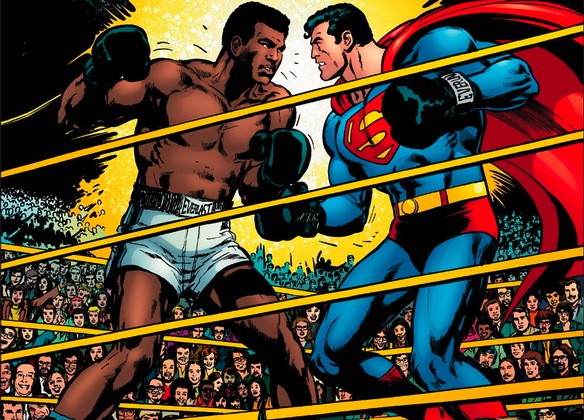
“The Fight of the Century” against Joe Frazier divided a nation while “The Rumble in the Jungle” against George Foreman united another. Perhaps his most courageous outing, “The Fight to Save Earth,” pitted Ali against the man of steel himself, Superman.

Neal Adams’ iconic cover of the 1978 Superman vs. The Muhammad Ali comic book has been seen all over social media since the passing of the boxing legend. While a fight of this magnitude is a really cool spectacle in the abstract, the story and pairing of these two iconic figures represents the enormity of something larger than ourselves.

Superman and Muhammad Ali are the most celebrated individuals of their genres. Both fought for truth and justice on their own terms while demonstrating a graceful resolve against any adversity. While Ali was called “the greatest,” Superman is considered Earth’s greatest hero. Ali, being able to “float like a butterfly and sting like a bee,” resonates similarly to Superman’s moniker of “faster than a speeding bullet” and “more powerful than a locomotive.”

The story, written by Dennis O’Neil, represents the best of reality and fantasy, trading fisticuffs in a fictional setting to save our world. The narrative captures Ali’s maverick virtue as he volunteers to fight the alien Scrubb fighter right as Superman steps forward. Superman believes he is the choice to defend the human race, while Ali contends that because Superman is an alien, he shouldn’t be the chosen one.

Once the Scrubb leader declares that the two will fight each other to determine who Earth’s greatest champion is, he plans to have Superman’s powers deactivated to make it a fair fight. Ali trains Superman in the finer points of the sweet science because he knows that even without his powers, Superman could win. If Ali lost the fight, Superman would need to refine his skills so the Earth has a better chance of survival.

When the fight begins, Superman makes a good account for himself until Ali’s style and guile prove to be too much, and Superman gets pummeled black and blue. Ali urges the referee to stop the fight because Superman won’t go down. Superman falls to the ground as the referee calls for the bell and declares Ali the winner.

Superman’s loss to Ali didn’t damage his credibility with readers, despite the racial tensions that existed at the time, because, well…he’s Superman. By the time the book was released in 1978, Ali had lost the heavyweight championship to Leon Spinks. That didn’t deter people from buying the famed comic because Ali was not just a top-level boxer but was a once in a lifetime athlete who epitomized greatness regardless of a win/loss record.

Muhammad Ali left an indelible legacy that will be celebrated long after we’re gone. His uncanny pugilistic skill is topped only by his courage to challenge authority regardless of the complexity of the political climate. I think it’s safe to say that if Superman was real, he and Ali would be really good friends. When the dust settles and the smoke clears, they both want everything to be alright with the world, and make no mistake about it, the world is a better place today because Muhammad Ali lived in it.

 Originally written for Forces of Geek.com on June 10, 2016